Mumbai Metro
Mumbai Metro: The Lifeline of a Modern City
Introduction
Mumbai, India’s financial capital, has long depended on its suburban rail network, buses, and taxis to move millions daily. However, as the city expanded northward and traffic congestion worsened, a modern rapid transit system became essential. The Mumbai Metro was conceived to provide a fast, reliable, and eco-friendly mode of urban transport — connecting residential suburbs, business districts, and major transit hubs efficiently.
Overview of the Mumbai Metro
The Mumbai Metro system is being developed in multiple phases to create a network spanning over 300 km when complete. The project is managed by different entities:
- Mumbai Metropolitan Region Development Authority (MMRDA)
- Mumbai Metro Rail Corporation Limited (MMRCL) – primarily for the underground Line 3
- Mumbai Metro One Pvt. Ltd. (MMOPL) – a public-private partnership operating Line 1
Each corridor is identified by a color and number, linking various parts of the city through elevated, at-grade, and underground routes.
Existing Operational Lines
Line 1: Versova – Andheri – Ghatkopar (Blue Line)
- Length: ~11.4 km
- Type: Elevated
- Stations: 12
- Opened: 2014
- Operator: Mumbai Metro One Pvt. Ltd. (Reliance Infrastructure and MMRDA JV)
This was the first operational metro line in Mumbai, connecting the busy western suburbs of Versova and Andheri with the central suburb of Ghatkopar. It drastically cut travel time from nearly 90 minutes by road to about 25 minutes.
Line 2A: Dahisar East – D.N. Nagar (Yellow Line)
- Length: ~18.6 km
- Type: Elevated
- Opened: 2022 (Phase 1)
Connecting Dahisar in the north to D.N. Nagar in Andheri, this line runs parallel to the Western Express Highway and relieves traffic pressure on the western suburban corridor.
Line 7: Dahisar East – Gundavali (Red Line)
- Length: ~16.5 km
- Type: Elevated
- Opened: 2023
Line 7 runs along the Western Express Highway and interconnects with Line 2A at Dahisar East, creating an efficient transfer between western and central suburbs.
Line 3: Colaba – Bandra – SEEPZ (Aqua Line)
- Length: ~33.5 km
- Type: Fully underground
- Status: Fully operational in 2025
- Operator: Mumbai Metro Rail Corporation Limited (MMRCL)
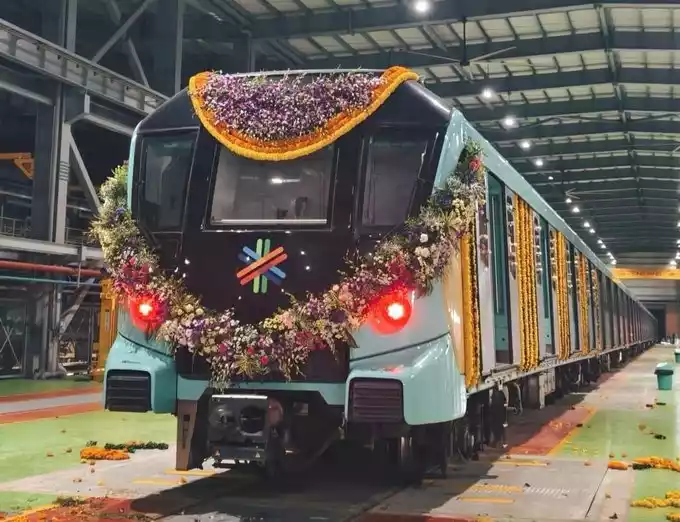
This is Mumbai’s first underground and fully driverless metro line. It runs from Cuffe Parade in South Mumbai through major business hubs like Churchgate, CST, Worli, Dadar, BKC, and the Airport Terminal, finally reaching SEEPZ in Andheri East. The line has 27 stations and is considered the backbone of Mumbai’s north–south metro network.
Fares and Ticketing
Mumbai Metro uses a distance-based fare system, which varies slightly between operators. Generally:
| Distance (km) | Fare (₹) |
|---|---|
| 0 – 3 | 10 |
| 3 – 12 | 20 |
| 12 – 18 | 30 |
| 18 – 24 | 40 |
| 24 – 30 | 50 |
| 30 – 36+ | 60 – 70 |
Smart cards, mobile QR tickets, and contactless tokens are available for all lines. The Mumbai One Card integrates payment across multiple metro lines and public transport modes. Monthly and trip passes offer fare discounts for regular commuters.
Interchanges and Connectivity
The metro network is designed to integrate with other modes:
- Suburban Rail: Key interchanges at Andheri, Ghatkopar, Bandra, Kurla, and Dahisar.
- Airport: Line 3 connects directly to both domestic and international terminals.
- Bus and Monorail: Interconnected stations at D.N. Nagar, Ghatkopar, and Chembur improve multimodal mobility.
- Business Hubs: Direct access to BKC, SEEPZ, Lower Parel, and Nariman Point reduces road travel drastically.
Lines Under Construction
Line 2B: D.N. Nagar – Mandale (Yellow Line Extension)
- Length: ~23.5 km
- Type: Elevated
- Expected Completion: 2026
Extends Line 2A eastwards across the city to Chembur, BKC, and Mandale in the eastern suburbs.
Line 4: Wadala – Kasarvadavali (Green Line)
- Length: ~32.3 km
- Type: Elevated
- Expected Completion: 2027
Connects central Mumbai to Thane via Ghatkopar, Mulund, and Teen Hath Naka.
Line 4A & 10: Kasarvadavali – Gaimukh & Gaimukh – Shivaji Chowk (Mira Road)
Extensions of Line 4 further north towards Mira-Bhayandar.
Line 5: Thane – Bhiwandi – Kalyan (Orange Line)
- Length: ~24.9 km
- Type: Elevated
- Expected Completion: 2027
A crucial corridor linking industrial hubs and residential clusters in Thane district.
Line 6: Swami Samarth Nagar – Vikhroli (Pink Line)
- Length: ~14.5 km
- Type: Elevated
- Expected Completion: 2026
An east-west connector between Andheri and the eastern suburbs, easing load on east-west arterial roads.
Line 9: Dahisar – Mira Bhayandar (Red Line Extension)
Extends Line 7 northwards, improving connectivity for commuters in Mira Road–Bhayandar.
Line 8: Airport – Mankhurd (Gold Line)
A proposed airport connector line linking the existing terminals to Navi Mumbai Airport (once operational).
Future and Proposed Corridors
Beyond Phase II, several additional lines are proposed or under planning:
- Line 10 & 11: Further northward and southward extensions of existing lines.
- Line 12: Kalyan – Taloja corridor.
- Line 13 & 14: Future orbital routes connecting Navi Mumbai, Panvel, and Mumbai’s periphery.
These will bring the total metro coverage in the Mumbai Metropolitan Region (MMR) to over 300 km, comparable to Delhi Metro’s scale.
Impact on the City
The Mumbai Metro is transforming daily travel. Commutes that once took over an hour now take less than 25–30 minutes. The air-conditioned, punctual, and safe service provides a much-needed alternative to overcrowded suburban trains.
Economically, it is boosting real estate values along the corridors, improving business access, and reducing vehicular pollution and road congestion.
Conclusion
The Mumbai Metro represents a turning point in the city’s transport evolution. From a single 11 km line to a multi-corridor network spanning the entire metropolitan region, it is reshaping how Mumbaikars move. As more lines open and integrate in the next few years, Mumbai is on track to become one of the best-connected metro cities in the world — with faster, cleaner, and smarter urban mobility.